
What Is Perimenopause and How Does It Affect Women’s Health?
Let’s imagine a typical situation that can happen to any woman over 40. A woman has been getting enough sleep, eating well, and exercising regularly, but at some point she begins to notice that she’s sweating more at night, her periods are irregular, and her mood changes quite often. Doctors say, “You’re still too young for menopause.” But for some reason, some of them forget to mention the term “perimenopause.” And the sooner you understand what perimenopause is, the more tools you’ll have to take control of your health.
What Is Perimenopause?
What is perimenopause? It’s a transitional period between reproductive age and menopause. It’s not menopause itself, but the journey toward it. It’s the time when the ovaries gradually reduce their production of estrogen and progesterone, and hormone levels become unstable.
Unfortunately, the key issue here is instability. This is because hormone levels don’t decline gradually as they do during menopause; instead, they fluctuate wildly and this is precisely what causes most of the symptoms that women describe as “something’s not right.”
Why Perimenopause Happens
As every woman ages, the number of eggs in her body decreases. The brain tries to “stimulate” the ovaries by releasing more FSH, but the ovaries respond less and less effectively. As a result, estrogen and progesterone are produced unevenly, and a woman’s cycle becomes unpredictable.
How Long Does Perimenopause Last
It’s important to set expectations right away. According to research, perimenopause symptoms last an average of 4-8 years (in some cases, they can last up to 14 years).
What Is the Typical Age for Perimenopause?
Most often, the first signs appear between the ages of 40 and 44, although for many, changes begin as early as 35-38. Of course, all these figures are highly individual, for some women, this period may not begin until ages 50-52. When exactly this happens is influenced by genetics, smoking (which accelerates the transition), autoimmune diseases, and ovarian surgery.
How Early Can Perimenopause Start?
How early can perimenopause start - as early as age 40. If the ovaries begin to decline in function before this age, it’s called premature ovarian insufficiency (POI). According to the Cleveland Clinic, this occurs in about 1% of women. If it happens before age 45, it’s considered early menopause.
In both cases, without treatment, the risks to bone health, the cardiovascular system, and cognitive function increase (study). Therefore, it’s important, first and foremost, to pay attention to symptoms and compare them with your age.
Common Perimenopause Symptoms
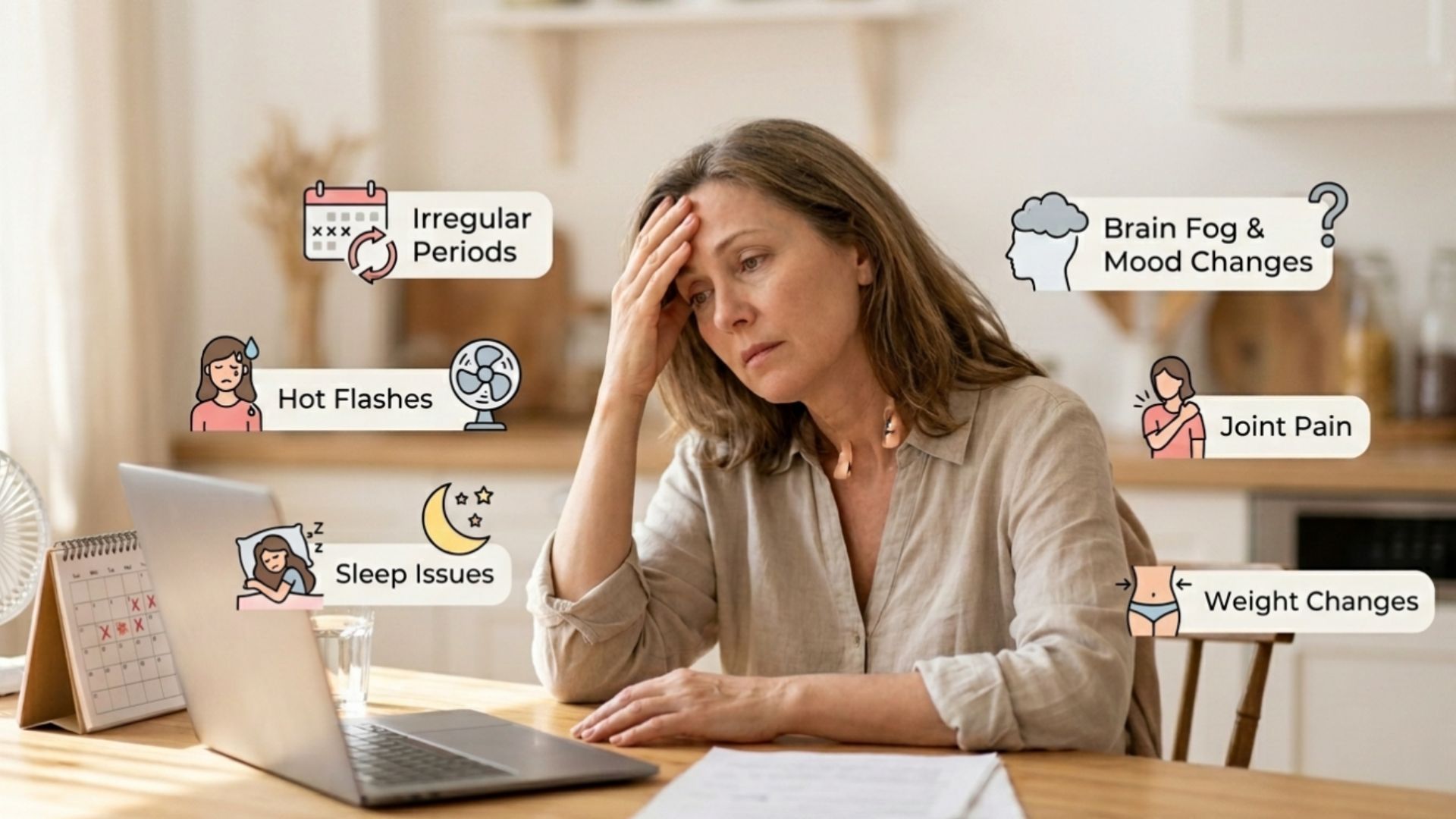
Now, let’s talk specifically about perimenopause symptoms. Unfortunately, the list is quite long, and it’s easy to dismiss them as stress or just part of your personality. That’s why it’s important to listen to your body so you can seek help in time.
Changes in Menstrual Cycles
Usually, the first thing a woman notices is that her cycle has changed: it may be shorter or longer, lighter or heavier. Ovulation occurs irregularly. While this is the most easily identifiable change, it isn’t always the first one; many women notice irritability, dramatic sleep disruptions, or weight gain years before any menstrual changes appear. An irregular cycle during this period is normal. However, heavy bleeding that does not stop is a reason to see a doctor.
Physical Symptoms
Hot flashes, night sweats, sleep disturbances, chronic fatigue, and weight gain around the abdomen, even without changes in diet. According to research, 70-80% of women experience sleep disturbances during the menopausal transition. Vaginal dryness, decreased libido, and joint pain are also common.
Emotional and Cognitive Symptoms
Anxiety “out of nowhere,” irritability, brain fog, and memory loss are classic premenopausal signs of hormonal imbalance. A study by BJGP (2025) showed that women are treated for “depression” or “anxiety disorder” for years without realizing that the root cause lies in their hormones.
Premenopausal Signs Women Should Not Ignore
Premenopausal signs to watch out for:
Your cycle has changed (become shorter or longer)
Sleep has worsened for no apparent reason, especially nighttime awakenings
Weight is increasing even though your diet hasn’t changed.
Anxiety or apathy has appeared “out of the blue”
Decreased libido
If you recognize yourself in at least two of these points, this is a reason to talk to a doctor who takes a comprehensive approach to hormone health.
Perimenopause vs. Menopause: What’s the Difference?
Perimenopause vs. menopause: The difference is that perimenopause is a process, while menopause is a specific point in time - a specific moment defined retrospectively as 12 months without a menstrual period. Everything before that is perimenopause. Everything after that is postmenopause.
Key Differences Between Perimenopause and Menopause
Perimenopause Menopause
Duration 4-14 years One moment
Cycle Irregular, but present Absent
Fertility Reduced, but possible Absent
Hormones Unstable, fluctuating Consistently low estrogen
Important note: During perimenopause, pregnancy is still possible, as long as you’re still having any periods at all.
How Perimenopause Affects Women’s Health
Unfortunately, the decline in estrogen isn’t just a source of discomfort; it has real, unpleasant consequences:
Bones. Estrogen protects bone tissue. As estrogen levels decline, bone loss accelerates, which is precisely why osteoporosis is significantly more common in women.
Heart and blood vessels. Before menopause, estrogen has a protective effect. Afterward, women’s cardiovascular risk approaches that of men.
Metabolism. Insulin resistance, rising cholesterol levels, and a shift in fat distribution toward the abdomen, all of these are consequences of hormonal changes.
The good news is that all of these can be monitored and managed with the right approach.
Managing Perimenopause Symptoms

Perimenopause is a normal stage of life. But you still need to know how to manage it:
Nutrition. Adequate protein (1 g per pound of ideal body weight), omega-3, vitamin D, magnesium, and calcium are nutrients that are especially important during this period.
Strength training. Not cardio, but weight training is the key tool for muscles, bones, and metabolism. Muscles act as a hormonal shield.
Sleep. 7-9 hours in a cool, dark room. Waking up at night is a symptom, not “just a part of aging.”
Stress management. This is often the elephant in the room when it comes to hormonal health - easy to overlook, but critical to address. Cortisol and sex hormones compete for the same resources. Chronic stress literally reduces hormonal potential.
When to Seek Medical Support
See a specialist if your symptoms interfere with work or sleep, your cycle has changed drastically, or you’re not yet 40 but are already experiencing signs of perimenopause. How early perimenopause can start is the starting point for a conversation about your specific body and plan.
At Tahoe Hormone Therapy, the first step is the Foundational Assessment: a 90-minute session with Dr. Katie, a comprehensive hormone panel, and a personalized plan. For women primarily interested in weight loss or menopause hormone therapy who want a more accessible way to get started right away, the Focused Foundational Assessment with Holli Miller, F-NP, is also a great option. Perimenopause isn’t the end of anything. It’s the beginning of a phase in which you have more tools at your disposal than you realize.
FAQ
1. What is perimenopause?
It’s the transition period leading up to menopause, lasting 4-14 years, characterized by hormonal fluctuations and a variety of symptoms.
2. What are the most common perimenopause symptoms?
Perimenopause symptoms: irregular periods, hot flashes, sleep disturbances, fatigue, weight gain, brain fog, anxiety, and decreased libido.
3. At what age does perimenopause begin?
Most often between ages 40 and 44, but not infrequently in the late 30s. Perimenopause age is an individual matter.
4. What are the premenopausal signs to watch for?
Premenopausal signs: changes in your cycle, waking up at night, unexplained weight gain, anxiety “out of nowhere,” decreased libido.
5. How early can perimenopause start?
Before age 40, this is considered premature ovarian insufficiency. It requires medical attention. This is exactly the question you should start your conversation with your doctor with.
6. What is the difference between perimenopause and menopause?
Perimenopause vs. menopause: Perimenopause is a process that lasts for years. Menopause is a specific point in time (12 months without a period).
This article is written for educational purposes and does not constitute medical advice.