
Why Building Muscle After Menopause Is Essential for Women
You’ve probably noticed that as you get older, it becomes harder to do certain things. And we’re not talking about athletic achievements, but rather everyday situations. For example, have you noticed that your grocery bag feels heavier to carry, or that climbing the stairs isn’t as easy as it used to be? On top of that, you’re gaining weight even though you’re eating the same as always.
After menopause, the body changes in ways we rarely notice directly: in our muscles. Building muscle after menopause is no longer just about achieving the perfect figure for social media. It’s about basic daily activities, ensuring your body remains strong, independent, and mobile for the next 30-40 years of your life.
What Happens to Muscle During Menopause?
With the onset of menopause, estrogen levels drop sharply, and this directly affects muscle tissue. Studies show that menopause is associated with a decrease in muscle mass and strength, as well as a shift in body composition toward increased body fat, especially in the abdominal area.
This phenomenon is called sarcopenia - the progressive loss of muscle mass and function. And while it also occurs in men as they age, the process accelerates significantly more rapidly in women after menopause.
The Connection Between Hormones and Muscle Health
Estrogen is not just a “menstrual cycle hormone.” It directly regulates metabolism and skeletal muscle function through estrogen receptors present in muscle tissue. When estrogen levels decline, muscles recover more poorly after exercise, grow more slowly, and are lost more quickly, even if lifestyle remains unchanged.
Why Building Muscle After Menopause Matters
But don’t get discouraged just yet, the good news is that what has slowed down can be sped up again. Strength training for menopause is one of the few tools that actually works against this process.
Improved Metabolism
Muscle tissue is metabolically active. It burns calories even at rest. The more muscle you have, the higher your basal metabolic rate. This is especially important after menopause, when your metabolism naturally slows.
Better Mobility and Independence
Your body’s mobility and independence are about living freely. It’s as simple as getting up from a chair effortlessly, picking up your grandchild, or carrying bags from the car. Muscle strength is directly linked to how independent you remain in your daily life.
Reduced Risk of Falls and Injuries
As you age, balance and coordination require special attention. Strong muscles stabilize your joints and reduce the risk of falls; unfortunately, falls after age 60 are common and can drastically change your life for the worse.
The Benefits of Strength Training for Menopause
Menopause strength training works on several levels at once, which is why it’s considered one of the most effective types of exercise during this stage of life.
A systematic review of strength training in women with sarcopenia showed significant improvements in grip strength, walking speed, and functional test results following a training program. In other words, the effect is not abstract; it is measured in concrete, tangible improvements in daily life.
Furthermore, strength training addresses the root cause of the problem, muscle tissue, directly. Mechanistic studies show that resistance training counteracts age-related muscle loss through several physiological pathways:
Stimulation of muscle satellite cells
Improved protein synthesis
Reduced tissue inflammation
Such workouts also help with osteoporosis, which often accompanies sarcopenia during this period. The connection runs deeper than most people realize: during resistance training, muscles physically pull on the bones they’re attached to, and that mechanical stress stimulates the synthesis of new bone tissue. This is critical during menopause, when bone loss accelerates - strength training is one of the most effective tools to actively counteract it.
Best Exercise for Menopause and Muscle Building
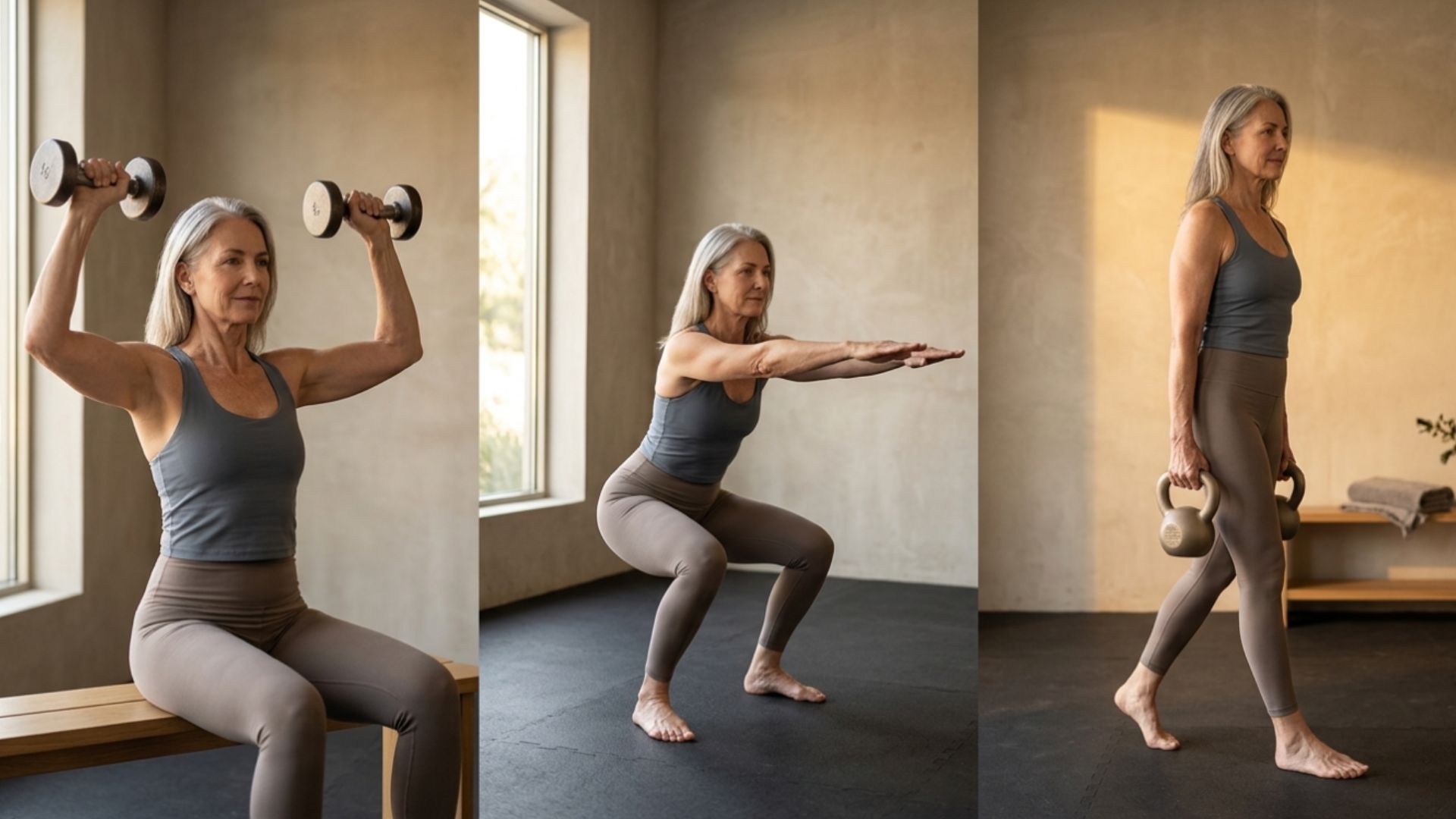
If you’re looking for the best exercise for menopause, the answer is quite clear: variety, but with an emphasis on strength training.
Weight Lifting and Resistance Training
Menopause and weightlifting are topics that are being discussed more and more often. Working with weights (whether dumbbells, barbells, or machines) sends a direct signal to the body to build and maintain muscle tissue. Dr. Katie O’Brien, who is a bodybuilder herself, never tires of telling her patients: “Lift heavy. It’s the most effective thing you can do for your body during this time.”
Bodyweight Exercises
Squats, push-ups, and planks are bodyweight exercises. They’re a great place to start, especially at home. They strengthen the same muscle groups and can easily be incorporated into more intense workouts later on.
Functional Fitness Activities
These are exercises that mimic everyday movements: lifting, bending, and carrying loads. They build not only strength but also coordination, skills that are truly useful in daily life, not just at the gym.
How Often Should Women Strength Train After Menopause?
Most research protocols on strength training for menopause recommend 2-3 workouts per week, with full recovery between sessions. This is enough to trigger positive changes in muscle tissue without overloading the body.
Consistency is more important than quantity. Two consistent workouts per week over the course of a year will yield better results than five intense workouts that leave you burned out after a month. Recovery between workouts is just as important as the workout itself; it’s during rest that muscles grow.
Nutrition and Building Muscle After Menopause
Workouts are only half the equation. Building muscle after menopause requires proper nutrition; otherwise, the body simply won’t have the “building blocks” for growth.
Protein and Muscle Maintenance
As we age, the body becomes less efficient at utilizing protein for muscle building - a phenomenon known as anabolic resistance. Studies show that older adults require a higher protein intake to stimulate muscle protein synthesis during strength training. We recommend consuming 1 g of protein per 1 pound of ideal body weight.
Supporting Recovery
Adequate water intake, a balanced diet of whole foods, and quality sleep create the conditions in which muscles can truly recover between workouts. Without these, even the perfect workout program will be only half as effective.
Getting Started With Menopause Fitness
It’s never too late to start, and you don’t have to try to become a bodybuilder right away. Menopausal fitness starts small: one strength-training session per week, gradually increasing the weight, and focusing on form rather than the speed of results.
If you’re unsure where to start, or if you have underlying health issues, it’s worth consulting a specialist who will take your entire hormonal profile into account, not just your workout program.
Building muscle after menopause isn’t about aesthetics. It’s an investment in what your life will be like when you’re in your 70s and 80s: whether you’ll be independent, active, and strong, or not. And that investment starts right now, with the first dumbbell in your hand.
FAQ
Why do you lose muscle after menopause?
A decrease in estrogen directly affects muscle tissue through receptors in the muscles, slowing recovery and accelerating muscle loss - a process called sarcopenia.
What exercises are best for women going through menopause?
The best exercise for menopause is a combination of strength, functional, and bodyweight exercises. Strength training is the most effective way to counteract muscle loss.
How often should you do strength training?
2-3 workouts per week, with sufficient recovery time between sessions, is the optimal frequency for menopause strength training, according to research protocols.
How much protein should you eat to build muscle after menopause?
At least 1 g of protein per 1 pound of ideal body weight per day (above the standard recommendation) to counteract the age-related decline in muscle sensitivity to protein.
Can I start strength training if I’ve never worked out before?
Yes. Menopause and weightlifting are suitable for beginners when the workload is increased gradually and proper technique is used. If you have any health concerns, you should consult a specialist before starting the program.
This article is for educational purposes only and does not constitute medical advice.